






Deer Park Institute
Himachal India
March 27-29, 2026
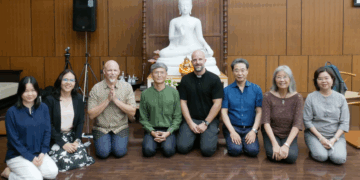
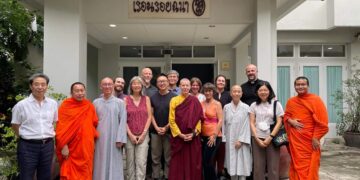
In our contemporary life, we often meet multiple challenges to the experience of well-being. Traditional Buddhist teachings point to how our experiences are shaped through our somatic experience (body), our communicative and energetic experience (speech), and our understanding of the world (mind). This 3-day experiential workshop for all comers used this traditional Buddhist framework to explore contemporary understandings and practices that inform well-being. The workshop involved meditation and contemplative practices, movement, and art. It was led by Dr. Elaine Yuen, a senior teacher and Upadhyaya in the Shambhala Buddhist community established by her teacher Chogyam Trungpa Rinpoche, who also taught as an Associate Professor of Religious Studies and Chair of the Master of Divinity Program at Naropa University. Serving alongside Dr. Yuen, were Pallavi Deshmukh—a dharma student in the Tibetan Buddhist tradition of her main teacher, Dzongsar Khyentse Rinpoche, and certified dance/movement therapy practitioner and visual arts facilitator, trained in Buddhist counseling—and Jonathan Watts—who has worked in chaplaincy development and suicide prevention in Japan for over twenty years after studying and practicing at the forest monastery of Buddhadasa Bhikkhu in Thailand in the 1990s.
Day 1: The Body: Establishing a Foundation for Reaching Out
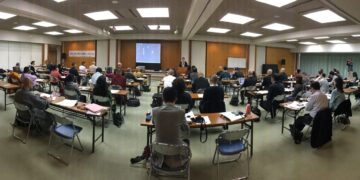
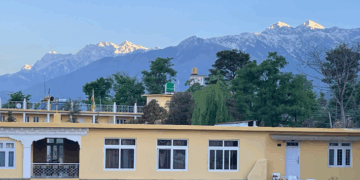
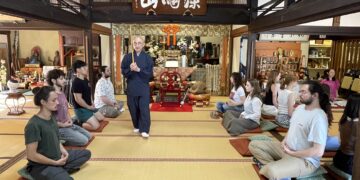
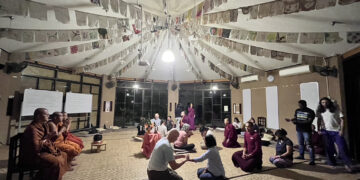
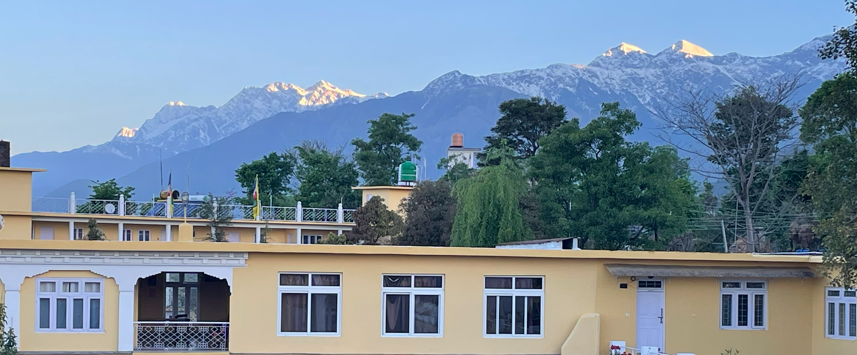
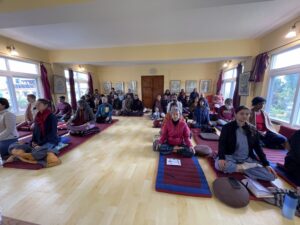
After a refreshing morning meditation with Elaine in the Manjusri Hall looking out at the snow-capped Himalayas, 41 participants gathered in the cozy Tara Hall of the Deer Park Institute. As usual at Deer Park, participants came from all over the world, yet a good majority were Indian. Both young and old, most have been searching for deeper meaning as well as deeper stability in a world engulfed in chaos and violence—perhaps the Kali Yuga as Hindus would call it or the Age of Final Dharma for Buddhists. Our first exposure to these struggles emerged in the opening round of self-introductions and responses to: Why have you come here for this workshop?
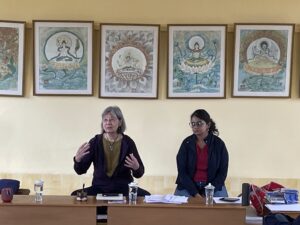
From this basis, Elaine provided an introduction and context for the workshop, which devoted each day to the three points of body, speech, and mind. To begin, she instructed everyone to take a seat and assume a posture of dignity that embodies spiritual warriorship imbued with compassion—reflected in the Shambala Warrior teachings of Trungpa Rinpoche. Then she spoke of the element of “body” in an expansive way that goes beyond physical and personal posture to encompass the environment. This includes not only the time of day and weather but also how we arrange a room—reflecting the natural interplay between the personal and environmental. Elaine then explained “speech” as what is verbal and energetic. Beyond the words that are spoken, this encompasses the quality and tone of our communication, our way of enunciating, the complexity or simplicity of our words, the pace of our speech, and even the gaps and intervals of silence. Finally, she explained “mind” as the content that is created and exists coming out of the first two elements. This includes what is taught and what is experienced. Ideally, a sense of balance and investigation comes from harmonizing these three elements so that a fundamental sanity and compassion emerges.
For the last hour of the morning, Jonathan led the group through meditation practice. Referring to the common foundations of all three yanas in the Buddhist tradition, he introduced the most ancient of Buddhist meditation systems, the Four Foundations of Mindfulness (satipatthana), based in the Pali discourses of the historical Buddha, Shakyamuni. While so many regard Buddhist meditation as a science of the mind or a practice focused on cultivation of the mind, this teaching of the satipatthana outlines how the physical body (kaya) and the energetic body (vedana) must be established and regulated before the third foundation of mind (citta) and the fourth of dharma can be contemplated. This ancient teaching is being rediscovered by many contemporary therapists and counselors, who have found patients need embodied practices like yoga or tai-chi to activate any insights they gain from cognitive therapy. Jonathan, having lived in Japan for over thirty years, led participants in a deep contemplation of the first foundation of body through the Zen emphasis on a straight and open posture. Such posture supports the energetic and cognitive systems to self-regulate in a natural way. Bringing in the Vajrayana tradition, Jonathan spoke of this as “waking down”, to quote Willa Baker’s The Wakeful Body, in which insight is regulated by and flows out of a grounding in our bodies and the earth.
After lunch and a siesta, Pallavi led spontaneous and gradual bodily awareness practices, progressing from slow deliberate movements and concluding with spaciousness and openness. Participants were guided to explore fully on their own how their body wishes to move by listening and responding to it. Simple instructions were given in the beginning and participants were encouraged throughout to allow movements to emerge with few reminders during the process. The objective was to allow each participant to feel and trust their natural movements without being focused on the need to make their movement performative. Gradually and eventually, their movement vocabulary expanded, while the qualities of “basic goodness” or “basic sanity” through embodiment were expressed. At the end, participants shared a single word feeling from the experience, with responses, such as “energetic”, “relaxed”, “freedom”, “open”, “spacious”, “more aware”, “playful”, and “fun”, being articulated. A few participants mentioned the common sentiment of: “I have always had two left feet all my life. I didn’t know I could move so well and have fun too!” In this way, the first day’s workshop moved from an awareness of one’s own body and personal space in the first satipatthana outward to an awareness of body in movement and in space.
After Pallavi energized everyone and had them explore the embodiment of basic goodness, Elaine went on to explore the body in social space. She did an adaptation of the Circle of Being, which comes from Mudra Theater developed by Trungpa Rinpoche. Participants stood in a circle, and selected individuals walked in and through the space. The group then talked about how the circle created a social space and the experience of walking near and far from each other as well as the feelings of being “inside” and “outside” of the space. Then, Elaine led the group in an exercise called “Field Dance” from Arawana Hayashi’s Social Presencing Theater. The entire group was arranged as an audience facing a single chair. Participants were then invited to mindfully walk up to the chair, sit, slowly gaze out at the “audience”, and then get up and mindfully walk off. Subsequent discussions included the nonverbal experience of the space, feelings of nervousness and comfort, the difference in sitting far and close, humor, and nonverbal changes to the felt sense of the social space.
Day 2: Speech: Diving into the Energetic Body and Cultivating Spaciousness
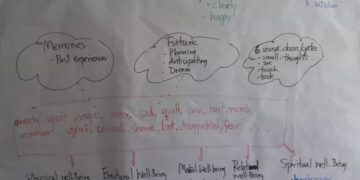
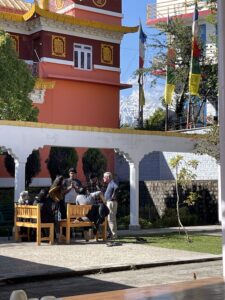 As an overview of “speech” on the second morning, Elaine spoke about how the communicative quality of speech creates a field of energy and vibration, which she referred to as the “social field”. She explained that there is an energetic quality in us that exists prior to our conceptions or conceptual field. “Speech”, thus, refers to how we are human together through body, breath, and awareness. “Speech” can involve individual processing, like writing a journal, but can also involve a public or collective way of processing, like the space in between each other. The issue then arises of how we might develop ”speech” as genuine expression? As a first step, participants were asked to notice how they resonate within a situation. After developing awareness and insight into the resonance, the next step was to cultivate kindness to ourselves and others. The final question or injunction was: What do we now do from this basis?
Pallavi then spoke about aspects of speech, such as the 4 speech acts of the 10 non-virtuous acts of Buddhism, which are: harmful lies, divisive speech, harsh speech, and idle gossip. On the other hand, there are the components of Right Speech (samma vaca), found in the pithy formula: Is it true? Is it kind? Is it necessary? Is it beneficial? Is it timely? Recalling the theme of authentic presence and basic sanity through our bodies, as we learned on the first day, Pallavi spoke about how a basic wisdom and spaciousness can be cultivated that empowers us to not get stuck in our views nor engage in neurotic speech. With this context, she led the group from the previous day’s Circle of Being into a Circle of Voice and Rhythm. Standing in a circle, participants put their hands on their hearts and bellies to come into contact with their breath and energy. Then, they followed their awareness outward to anything in the environment through the five senses while watching various states of awareness rise and fall. Next, they were instructed to mingle and follow anyone in voice who spontaneously began to call out one of five vowels (a-e-i-o-u). Joining them in sounding the vowel out, participants kept moving, suddenly shifting to new vowels as other participants chose to vocalize them. There was no goal or expected outcome for this activity, but rather for participants to experience this pre-cognitive state of body and energy. In the reflection period, participants were asked: What did you notice shift or change? Pallavi noted that this exercise can help people to open up without having to use words, ideas, and opinions. Elaine concluded that Trungpa Rinpoche encouraged students to engage in art and the various practices around perception and expression, which he called Shambala Art.
In the final hour of the morning, Jonathan led the group through the second satipatthana of mindfulness called in Pali or Sanskrit as vedana, which is another way of expressing “speech”. This term is often translated into English—a Buddhist poor language—as “feeling”. However, vedana is not emotional feeling, but rather the visceral feeling of positive, negative, and neutral impulses, which concoct into various qualities or perceptions known as sanya. Pallavi noted in the previous session how cultivating “speech” by returning to authentic presence and basic sanity empowers us to not get stuck in our views. Indeed, this point traces back to the earliest teachings of Shakyamuni Buddha as found in the Brahmajala Sutta in which he critiques the many existential views of his time. His criticism, however, is not based in their faulty logic but rather in their ignorant or dysregulated vedana that has concocted craving (tanha) and clinging (upadana) to such views. In Bhikkhu Analayo’s remarkable commentary on the satipatthana called The Direct Path to Realization, he writes about this discourse: “Logic and thought often serve merely to rationalize already existing likes and dislikes, which in turn are conditioned by the arising of either pleasant or unpleasant [visceral] feeling (vedana).” (p. 162)
 Jonathan then connected these insights with recent discoveries in modern therapy, such as Polyvagal Theory developed by Stephen Porges. Polyvagal Theory indicates that a change of state rather than a change of perspective or attitude, as in Cognitive Behavioral Therapy, is fundamental to developing holistic well-being. Porges’ concept of neuroception as a “social engagement system” of the energetic body that scans the environment, bodily sensations, and social cues to detect safety, danger, or life threat is very compatible with the social space practices that Elaine and Pallavi had been leading the group through.
From this context, Jonathan led the group through a meditation in which they established the first satipatthana of body and posture and then began to explore the second of vedana. Participants were first instructed to become aware of the breath as the gateway to the vedana. Then, they were instructed to look more deeply into the “tone” of their bodies. This tone is not experienced in words but more deeply felt as a sound, resonance, or vibration. Observing the tone, they were asked whether it was familiar, like a kind of default daily tone, or perhaps something new and different arising at this time. Next, participants were invited to become aware of and listen to a specific place in the body calling out for attention, the “feeling” could be either positive, negative, or neutral. Honing in with their awareness, they were instructed to inhale into the vedana and then through it and out of it with the exhale, like diving down into water, swimming through the water, and exhaling up for air. This is a practice of “touch and go”, as Trungpa Rinpoche would say, where one does not deny a feeling nor indulges or gets stuck in it. The inhalation while seeming to lead into an intensified experience of the vedana also provides greater space and openness through breath and awareness. This space allows for anything that is stuck to then be dislodged, moved, and eventually “liberated” through the exhalation. For those experiencing overwhelming vedana, a final cue was offered in the practice of “touching the earth” by reaching and touching the floor and regrounding themselves in the first satipatthana, as Shakyamuni did himself when battling his inner demons (mara) on the final night of his enlightenment.
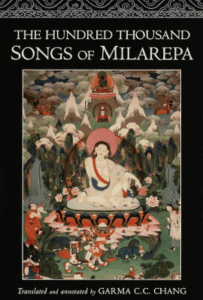 In the afternoon, Pallavi led the group in an art activity asking them to express the feelings that were created from the morning’s session on paper with crayons and colors but without words. At the end, participants were instructed to write a one word feeling on the back of the paper to encapsulate the art. Then participants were sent to wander outside with their art work, and after a bell prompt, meet someone and begin to share. They were asked to be mindful of their speech by not digressing in their explanation nor getting overly analytical. After tea break, the group gathered in a circle for single word sharings of their art works. From this point, everyone then wrote a phrase around the single word image on the back of their paper. The papers were then all collected and read aloud by Pallavi, creating a long poetic set of images like a Tibetan doha, which are spontaneous songs of realization by mahasiddhas and yogis such as Milarepa. Elaine then commented on the meme, “first thought, best thought”, coined by Trungpa Rinpoche with his student and renowned Beat poet Alan Ginsburg. Elaine explained this phrase as meaning not the first conceptual ideas that come into the mind but more the feeling or sense that arise before interpretation comes in–like the moment of glimpse in meditation which is authentic and genuine. The point seemed to bring us back to her introduction to “speech” on the first day and the question: can silence also be communicative as the non-dual aspect of voice and speech?
The day finished with Elaine providing an introduction to “mind” to prepare for the final day of the workshop. The group watched a short video of Mingyur Rinpoche explaining the three union features of mind: Awareness, Love&Compassion, and Wisdom. His key emphasis was moving away from a pre-occupation of what is wrong with ourselves, as is so common in modern therapy, to a cultivation of the fundamental qualities of sentient being. So instead of “fixing” our problems, the focus is more on developing the positive qualities beyond or behind these problems. Elaine explained this as discovering our basic goodness or sanity, which includes the “genuine heart of sadness”. From this standpoint, she said, we begin to appreciate our world and our sense perceptions in a more concrete and fundamental way, like in making and enjoying a cup of tea. Elaine spoke of the immense space around perceptions. This is how we practice “first thought, best thought”. While we tend to get caught up in struggling with all these methods in training, it is important to simply relax as we are and have no fear of this relaxation. We can extend kindness to our problems and our inner storms. This attitude can then expand and extend to others. A “vivid faith” in such experience can result as well as a “longing faith” to recreate it and train to develop it, which leads to a “confident faith” that it is here and true. From here, the three forms of wisdom (prajna) emerge as Hearing-Contemplation-Meditation, which offer a way to actually try things, experience them, and find out what’s worth using. Elaine then concluded the session by singing a doha of Milarepa’s encounter with a wealthy female patron named Balpradon.
Day 3: Mind: Making Friends with Ourselves and Extending to Others
The morning began with guided meditation by Pallavi and a reading from Trungpa Rinpoche’s Mindfulness in Action, which speaks about making friends with ourselves through dignity and simplicity.
Meditation practice is not an exotic or out-of-reach approach. It is immediate and personal, and it involves an intimate relationship with ourselves. It is getting to know ourselves by examining our actual psychological process without being ashamed of it. We are often critical of ourselves to the point where we may become our own enemies. Meditation is a way of ending that quarrel by making friends with ourselves. Then we may find that we are not as bad as we thought or had been told we were … If we label ourselves as hopeless cases or see ourselves as villains, there is no way to use our own experience as a stepping-stone. If we take the attitude that there is something wrong with us, we must constantly look outside ourselves for something better than we are. That search can continue indefinitely … on and on and on. (pp. 3-4)
To expand on the teachings of mind begun the previous afternoon, Elaine gave a commentary on the Ten Oxherding Pictures, which were developed by the Chan/Zen tradition in China and were also commented on by Trungpa Rinpoche in The Teacup and the Skullcup: Where Zen and Tantra Meet. Elaine explained that the ox or bull is a metaphor for mind in Zen, yet this metaphor amazingly goes back to the Buddha’s use of it in the Satipatthana Sutta itself. Being very powerful and muscular, it is a place to begin our investigation and training.
- In Stage 1, The Search for the Ox, we find the young pilgrim searching for the ox as a metaphor for the curiosity we develop in wondering what could help us make sense of the world. This is the stage before we encounter meditation.
- Stage 2 is called Discovering the Footprints and the text reads: “Alongside the riverbank under the trees, I discover footprints. Even under the fragrant grass, I see his print. Deep in remote mountains, they are found. These traces no more can be hidden than one’s nose, looking heavenward.” This marks the discovery of the teachings and the path, yet “the gate has not been entered”.
- In stage 3, Perceiving the Ox, one has begun to practice and starts to get a feeling for mind and awareness.
- In Stage 4, Catching the Ox, the pilgrim as metaphor for one’s own search has caught the ox-mind, but the mind is not so easily tamed and pulls away stubbornly. This represents that initial stage of struggle as the romantic idealism of encountering the teachings fades.
- In Stage 5, Taming the Ox, one has developed and can “control” the mind as it were, but “the whip and rope are necessary” as discipline, until it becomes naturally gentle and unfettered.
- In Stage 6, Riding the Ox Home, the pilgrim rides the ox with dignity while playing their flute in an act of musical magnetism, reflecting the joy that can be found in practice.
- In Stage 7, The Ox is Transcended, one reaches “the home” of natural mind, and now the ox can rest with the whip and rope abandoned.
- Stage 8, Both Bull and Self Transcended, is the picture of the Zen enso 円相, representing sunnata (emptiness), vast creative openness, and what would seem to be the culmination of the path. Yet there are two more pictures.
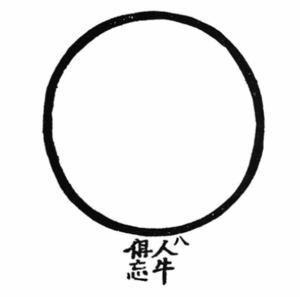

- In Stage 9, Reaching the Source, one sees the world with new eyes and develops appreciation of what is—expressed as trees and birds by a riverside within the enso. Buddhist enlightenment is not an escape or a negation of the world but a re-evaluation/re-valuation of it from a mind no longer obscured by greed-anger-delusion.
- Stage 10, In the World, goes: “Barefooted and naked of breast, I mingle with the people of the world. My clothes are ragged and dust-laden, and I am ever blissful. I use no magic to extend my life; Now, before me, the trees become alive.” Beyond the artifice of wealth and spiritual materialism, enlightenment is portrayed as a full encounter with the world and the people in it; an enlightenment that goes beyond personal achievement and well-being to collective awakening and peace. Quoted text from Paul Reps translation in Zen Flesh, Zen Bones. (Tokyo: Charles E. Tuttle publishing, 1957). pp. 138-147
To conclude this session, Jonathan led the group in a meditation practice of “aimless wandering mind” as an expression of the third satipatthana of mind (citta). Sitting in “regal” and comfortable posture, participants then regulated their energetic bodies through awareness of the breath. From these first two foundations, they were encouraged to observe the mind as the pilgrim first encountered the ox—not with an immediate desire for mastery and control but with a sense of curiosity and appreciation. This is done by allowing the ox-mind to roam as it wishes with no fear or judgement of its movements. Without an appreciation of the first two satipatthana, it may seem rather mysterious or difficult to understand how one can watch the mind while constantly identifying with the mind. By expanding our awareness of our beings beyond mind, we may then observe, tame, and ultimately transform the mind by establishing the other satipatthana.
After break, the group watched another video by Mingyur Rinpoche on making friends with the monkey mind. Quite aptly during this time, a whining cat had entered the teaching hall. At first, attempts were made to remove it, but it kept coming back and whining loudly. It eventually located a woman and curled up quietly in her lap—the monkey-ox-cat mind trained not through “the whip and rope” but through safe, warm, and loving space. Elaine then concluded with another contemplative mind-heart practice, loving-kindness maitri meditation using the Tibetan method of Tonglen in which one breathes in difficult emotions and exhales enlightened ones. She explained that in this practice one acknowledges one’s own difficulties but extends wellness to others, and in doing so makes friends with oneself (maitri) as well as extends compassion to others (karuna). She then requested everyone to choose a person in their mind with whom to practice Tonglen: to take in their difficulties and extend well-being out to them. This was followed by another reading from Trungpa Rinpoche’s Mindfulness in Action:
When you appreciate yourself, you realize that you don’t have to feel wretched or condemned. You don’t have to artificially puff yourself up, either. You discover your basic dignity, which comes along with gentleness. You have always possessed this, but you may never have recognized it before … This friendship with yourself is the basis, and the goal, of the practice of meditation. Meditation helps us to develop mindfulness and awareness, which allow us to gain another dimension of understanding ourselves. This makes us better friends to ourselves and to our world. Even before meditating, however, we can cultivate basic kindness toward ourselves. Without it, we have no way to move forward. (pp. 12-13)
Elaine concluded by reflecting on Trungpa Rinpoche’s first talks on the Shambala path and basic goodness, “We don’t have to be afraid of who we are”.
In the afternoon, Pallavi again engaged the group in a reading from Mindfulness in Action:
The practice of meditation is about trusting yourself. As the practice becomes a more prominent feature of your daily life, you not only learn to trust yourself but you might begin to actually love yourself, or to have a compassionate attitude toward yourself. As much basic space as you discover in your practice, there is that much warmth in the space as well. There’s a delightful feeling of positive things happening in you, constantly. Your meditation is no longer mechanical or a drag, but it is a delightful thing to do. Meditation is making friends with yourself … Having made friends with yourself in the practice of meditation, you can’t just contain that warmth within yourself. You have to have an outlet for it. That outlet is communication with the world outside, with the other side of the bridge. Compassion acts as the bridge. Otherwise, it is possible that your practice of meditation might become self-satisfying … if you exclusively practice meditation with no element of compassion in it, that kind of self-contained, self-satisfying practice could contain aggression … Compassion is not logical. It’s basically spacious and generous. A compassionate person might not be sure whether he is being compassionate to you or whether you are being compassionate to him, because compassion creates a total environment of generosity. Generosity is implied; it just happens, rather than you making it happen. It’s just there, without direction, without me, without “for them”. It’s full of joy, a spontaneously existing grin of joy, constant joy. (pp. 52-53)
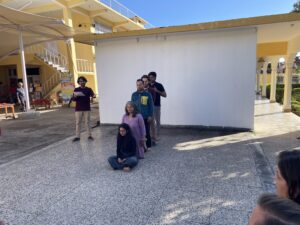
For the last part of the workshop, Elaine, Pallavi, and Jonathan gave the participants time to create their own group presentations, reflecting their learnings of the past three days. Based on the prompt, “How would you offer to the world awareness, love&compassion, and wisdom in body-speech-mind?”, participants broke into groups of six persons and were given an hour to come up with their own creative presentations. What ensued went far beyond the expectations and even imaginations of the three workshop leaders. Setting up in an open courtyard between the main Buddha hall and eating hall, ten different groups gave a fantastic display of creative group theatre that goes beyond the ability to describe in a narrative here. If there was a single common theme, it was individual participants taking on forms of conflicted and damaged inner self while other individuals helped negotiate and eventually embrace and liberate through “awareness, love&compassion, and wisdom”. While there were many highlights and fascinating experiences during the three days, these concluding pieces of what might be called Mudra Theatre definitely brought the entire workshop to a grand and fulfilling conclusion.
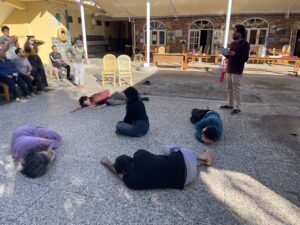
While Elaine, Pallavi, and Jonathan have been collaborating together for a few years within the context of IBCC, this was the first time they had worked together to create an entirely new workshop based on the conceptual thread of body-speech-mind. Beyond their collective devotion to Chogyam Trungpa Rinpoche’s teachings, it seemed it might be difficult to blend and harmonize their diverse interests and backgrounds. Yet somehow, collectively, they expressed a bit of the wisdom and compassion of body-speech-mind from all three Buddhist yanas, and the amazing participants listened, experienced, and integrated much of what was offered. In this way, the three workshop leaders would like to express their gratitude to Deer Park’s directors, Prashant Varma and Pravin Shakya Baudha, for putting them together and, with very little guidance, getting them to stage their own crazy three-day theatre. I guess we three were also then full participants in the workshop!