








Borobudur, Indonesia
February 9-13, 2026
Have you faced death directly before in your own mortality? Have you sat with someone in their last stages of life? Have you contemplated taking your own life? Have you worked with persons so desperate that they simply wish to “disappear”, unable to die but unable to live?
Facing death directly with mindful awareness and grounded embodiment is a practice taught through all Buddhist traditions, from the Buddha’s Four Foundations of Mindfulness (satipatthana) to the Heart Sutra’s 般若心経 exhortation of “no birth, no death” to the Pure Land practice of welcoming Amitabha at the moment of death 来迎 to the Tibetan practices of the bardo. These practices not only help transform the deep psychological distortions of our fear of death but also empower us to deal with the loss and grieving of loved ones as well as wider forms of loss, like war, genocide, and environmental destruction.
For a Buddhist based therapist or a counselor who is interested in using Buddhist teachings, how can these ancient practices be applied today to our largely urban, capitalistic societies where mental health is such a problematic issue and a massive generation of elderly need support in their final days?
This three-day workshop sought to provide:
1) knowledge of the fundamentals of Buddhist based counseling,
2) role plays and group work to internalize them, and
3) experiential practices to confront death and gain new insights from the deepest of Buddhist meditation topics.
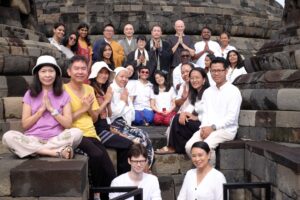
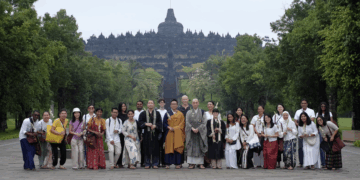
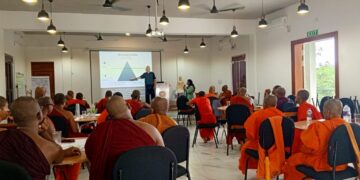
These were the prompts and introduction to IBCC’s first regional training workshop for Buddhist-inspired counselors held at the sacred ruins of Borobudur in Central Java, Indonesia during the week of February 9-13, 2026. While an earlier such regional program had been organized by IBCC members in 2023 before the creation of the institute itself, this workshop represented a much clearer and systematic approach to the training work.
Firstly, one of the lessons learned from the 2023 program is the difficulty of mixing Buddhist monastics training in chaplaincy with lay persons, some not even Buddhist, seeking to develop Buddhist-inspired skills to work in volunteer or professional contexts. In short, the training or re-training of Buddhist monastics and the contexts in which monastics serve, often within the confines of the temple, are a very specialized endeavor. The education and training of lay persons across the vast cultural regions of Southeast and South Asia for a wide variety of contexts—such as civil war, environmental degradation, urban disconnection and mental illness, and even pet-based therapy—requires a more “secular” approach in skills. They may be imparted more as “dharma” than Buddhism and are often synthesized with modern psycho-therapeutic methods. The former endeavor to work with monastics was undertaken by IBCC in March 2025 with a three-day course on suicide counseling for Thai and Myanmar monastics and in September 2025 with a two-day introductory course to Buddhist chaplaincy and counseling with Sri Lankan monastics.
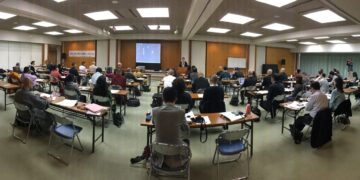
This Indonesian program was the first in-person workshop for lay counselors and therapists. It was built on the foundation of IBCC’s inaugural on-line course, The Bodhisattva Path of Care (BPOC): Compassion and Skillful Means in Buddhist Counseling, a three-month intensive course. Of the 21 participants from 7 different nations (Sri Lanka, India, Myanmar, Cambodia, Indonesia, Singapore, and Spain), 9 had either started or fully completed the course, which ran from March-July of 2025. One of the main instructors for the workshop—Nida Shaikh of the Manah Center for Mental Well Being in Pune, India—also serves as one of the three main instructors for the on-line course. In this way, the workshop was a deeper step into experiential practice for those who had begun their study and training in the previous year.
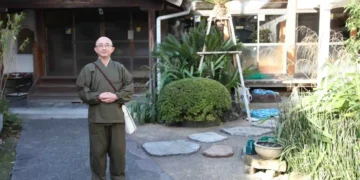
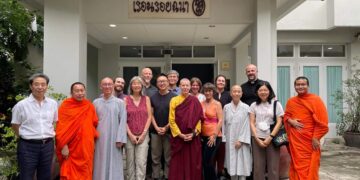
Together with the three Indonesian graduates of the BPOC course, the above theme and consequent curriculum was developed. One of these Indonesian participants, Hendrick Tanuwidjaja—a mindfulness instructor from Jakarta—had journeyed to Thailand the previous March to attend the first international staging of Rev. Nemoto Jotetsu’s compelling Departure (tabidachi) workshop on death. Rev. Nemoto’s work has been well regarded in Japan for the past two decades, and he served as the main instructor for the aforementioned suicide prevention workshop for Thai-Myanmar monastics. It was Hendrick’s inspiration and great endeavor to host the program in his native Indonesia—a place which has little access to Buddhist-inspired training programs—and to hold it near the hallowed grounds of Borobudur, a place that holds deep resonance to Hendrick as a Vajrayana Buddhist practitioner. Rev. Nemoto served as the instructor on the first day of the workshop.
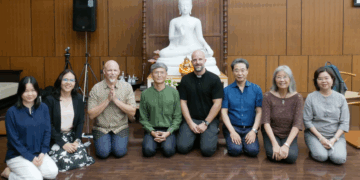
The instructor line-up was filled out by two priests of the Japanese Pure Land Jodo Shin Hongan-ji denomination, Japan’s largest traditional Buddhist sect. These instructors—Rev. Takemoto Ryogo and Rev. Fujii Kazuha—are a co-founder and trained counselor of Sotto, the Kyoto Self-Death & Suicide Counseling Center, one of Japan’s foremost Buddhist-based suicide prevention groups formed in 2010. For the last fifteen years, Sotto has trained 230 Buddhist priests, priests of other religions, and secular lay persons in their unique form of “sitting close by” (sotto) and developing deep listening and emotional resonance skills.
While there can be pitfalls in having too many instructors in a short-term workshop (i.e. “too many cooks spoil the stew”), the organizers and instructors were able to design an integrated program that mirrored the fundamental approach of the Buddha’s Four Foundations of Mindfulness (satipatthana). Day 1 brought the participants together and created a deep bond through the full day experience of Rev. Nemoto’s Departure workshop. His teaching of Zen meditation in which posture and the five senses form an essential grounding followed by the intense experience of recreating one’s physical death created the basis of the 1st foundation of mindfulness, kaya, that is, the body. Day 2 entailed working with the Sotto counselors on emotionally resonating with those in deep suffering. Using the heart more than the head, Revs. Takemoto and Fujii led participants through an encounter with the 2nd foundation, vedana, the energetic body that feels and resonates. Day 3 involved working with Nida and her highly skilled integration of modern psychotherapeutic models and Buddha dharma to provide the cognitive skills and analytical tools of the 3rd foundation, citta, the mind-body. The 4th foundation, dharma, seemed to pervade all three sessions, and so the workshop unfolded rather seamlessly.
Highlights of the Departure (tabidachi) Workshop
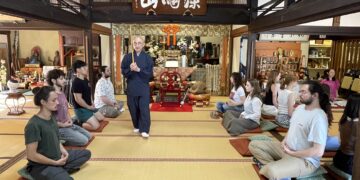
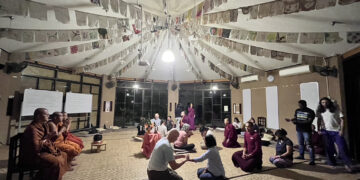
The morning of the first day involved getting participants connected into the space, first through some opening ceremonies of setting intention and dedicating merit to all sentient beings. There was also a one-hour pair and group sharing session on the core question: “What is death to you?” led by Hendrick Tanuwidjaja. The context for the Departure workshop was then created with an introductory talk by Rev. Nemoto on his journey from a divorced family in Tokyo, to days of being a “bad boy” on the streets of Tokyo in his teens and early adulthood, to his embracing of Buddhism after a near fatal motorcycle crash, onward to six years of rigorous Zen monastic practice, and finally his “reverse ordination” of re-joining society to work on behalf of the suicidal.
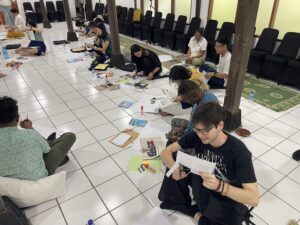
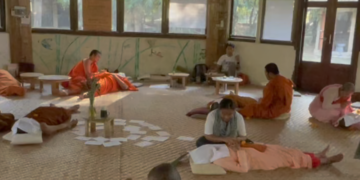
Participants were welcomed back in the afternoon to a session of basic instruction in Zen meditation. Unlike other forms of Buddhist meditation, Zen meditation, or zazen, involves very little instruction or teaching of methods. Simply, there is a great emphasis on maintaining a straight upright posture, then simply following the breath and becoming increasingly aware of the five senses. The practice is, therefore, amazingly direct and alarmingly uncluttered, with no techniques for the ego to hide behind or within. With the participants quiet and somewhat pensive awaiting instructions for death, Rev. Nemoto then unexpectedly had them engage in a one-hour Vision Board exercise. With a piece of white posterboard, a large pile of random magazines, glue, colored pens, and personal photos, participants created a collage of impressions of their lives—again, as with the zazen—with little explanation of purpose or goal. Participants seemed to enter a liminal place in their life experience, becoming children again making art, either quietly in a corner or yapping together with others.
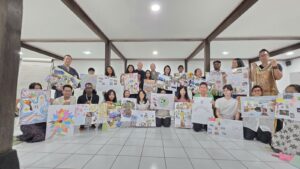
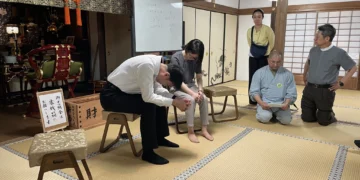
After posting their Vision Boards on the walls and taking a short break, participants were suddenly drawn back into the theme of confronting death. Each participant was given 12 post-it slips, three each of four different colors, which corresponded to four themes: most important people in one’s life, most important possessions in one’s life, most important activities in one’s life, and most desired things to do before one dies. With these established and taking a meditative posture, Nemoto led participants through an imaginary scenario of themselves at the center in which they become diagnosed with terminal cancer and slowly lose their faculties to live independently. At each stage, Nemoto instructs them to throw away two or three of these posts as things “you can no longer be, have, or do.” The scenario ends on one’s deathbed surrounded by grieving loved ones while paralyzed and unable to speak, and then eventually fading away and “becoming the wind” (ka-ze-ni-natta)—and the last post is thrown away.
The final stage involves a “mock funeral” in which one has turned back from the tunnel of light of death and returns to consciousness in the hospital room. With only a random nurse left cleaning up the room to attend to you, the participant has ten minutes to express their final thoughts, feelings, and gratitude to others. In this role play, two participants act as partners with one serving as the nurse providing “presence” and deep listening while the dying patient has a white scarf covering their face during their time of reflection. In this way, the workshop provides a space to not only come to terms with one’s own existential issues but also to practice the counseling and chaplaincy skills of being a compassionate companion to the suffering.
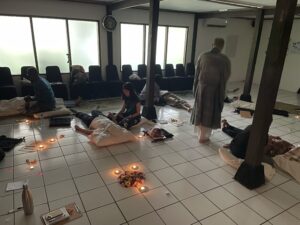
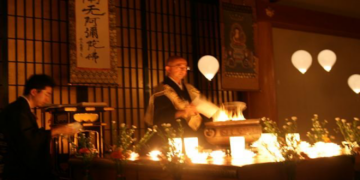
At the end of the ten minutes, Rev. Nemoto rang a bell and began chanting as during a funeral. After participants have experienced both roles, the session was brought to a conclusion, but participants were asked to maintain “noble silence” during dinner break. When they came back for the evening reflection session, they were first guided by Rev. Nemoto through the dark of the evening around the grounds of the forested resort while holding individual candles—a symbolic re-entry to the world of the living. The final session was an individual reflection on the workshop and sharing of each participants’ Vision Board, for which Rev. Nemoto provided a diagram of spatial symbolism for analysis.
This is only the second time this workshop has been done outside of Japan, the first being in Thailand in March of 2025. Rev. Nemoto has commented both times about how fascinating it is to learn the inner life, especially through the vision boards, and the ways of confronting death of non-Japanese peoples. It has been a new window for him to understand human life. Nida Shaikh, in observing the workshop, also commented with fascination at the way participants experienced their final moments through the way they held their feet, some still filled with tension expressing a life of continual perseverance. During the Vision Board reflections in the evening, many of these emotions came to life through stories of those who have experienced devastating war in their countries. One participant also was a cancer survivor, and she gave a deeply moving presentation on how Rev. Nemoto’s death scenario mirrored her actual experience and her gratitude at having returned from the precipice of death. While this specific workshop was a very adventurous activity to begin the three-day program, it also created a deep bond among the participants as well as a heightened perspective for the work to come in the following days.
Highlights of the Sotto Counseling Workshop
On the second day, participants were brought into an entirely new world of Buddhist based counseling, perhaps one that found more resonance for the few participants with Christian backgrounds. The global trend in mindfulness-based counseling and Buddhist-based counseling is that therapists use the power of their own meditation practice to provide compassionate presence and non-judgmental, deep listening to those in suffering. This method is seen as providing a mirror to the person for them to then discover their own wisdom and solutions to their problems rather than creating a co-dependent relationship on the therapist as the source for solutions. The Jodo Shin Pure Land priests of Sotto, however, have developed an entirely different approach, first from the teachings of their own tradition. Pure Land Buddhism, especially the Japanese form, emphasizes the lack of personal agency (known as “self-power”, ji-riki 自力) to practice and achieve the classical Buddhist system of ethics-meditation-wisdom (sila-samadhi-prajna). Instead, one deeply embraces one’s imperfect nature as an “unenlightened fool” (bonbu 凡夫) and devotes themselves to the “other-power” (ta-riki 他力) of Amitabha Buddha through the recitation of their name南無阿弥陀佛 (Jp. namu-amida-butsu). Through this encounter with the absolute, non-judgmental compassion of Amitabha, one finds warmth, assurance, faith, and well-being for this life as well as the assurance of being “born” (往生 ojo) into Amitabha’s Pure Land at death.
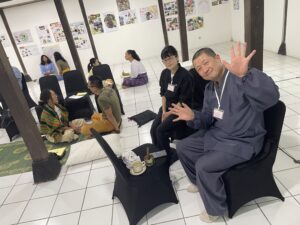
Sotto, with inspiration from the Christian-based methods of the International Befriender’s suicide prevention network, have thus developed a unique form of Buddhist counseling based on “gently being by another’s side” (sotto) and creating a sense of “relief” (hotto) through the warmth, exemplified by Amitabha Buddha. Rev. Takemoto explained in his introduction: “Just having someone by my side who stands by me as an ally is enough to become a pillar of support for living and eases the loneliness”. Rev. Takemoto’s own life—as a young child bullied at school who struggled to find meaning in life but found Buddhism as a way “to help others struggling with worries like my own”—gave credence and power to this introduction to the Sotto and Jodo Shin method of counseling.
His colleague, Rev. Fujii Kazuha, then led the group in a morning World Café workshop to enter into this world of loneliness and finding relief from it. Rev. Fujii, herself, was born as the daughter of a Jodo Shin Pure Land priest, as the denomination has practiced clerical marriage since its founding by Master Shinran (1173-1263) in the 13th century. After studying aspects of chaplaincy as a graduate student of her denominational university, Ryukoku University, she was drawn into suicide prevention work by the founders of Sotto, especially Rev. Takemoto. Since 2015, she has been part of a group of young priests known as Waka-zo 若僧 and planned and run Death Cafés, as a place to casually discuss death. She also helped to create Death Tourism Playing Cards, illustrating views on life and death from around the world. She completed the full Sotto training process to become a certified counselor in 2013.
World Café workshops are, in short, a way to generate the collective intelligence, abundant wisdom, and ideas of participants by conducting conversations and dialogues in a relaxed, café-like atmosphere with small groups, while changing participants. For this particular café, the first question for participants to discuss was: “When you feel very lonely, who would you like to talk to?”. This was followed by a change of groups and the question: “When do you feel loneliness intensely?” The café came to a conclusion with individual reflection on the question: “Briefly articulate the attitude you want to cherish.” “Attitude” here meant the kind of attitude or comportment you would like to receive from another when feeling lonely and in turn cultivate as a counselor of others experiencing loneliness. Participants were asked to write this down on a piece of paper.
This last question created the basis for the first stage of counseling practice in the afternoon. Participants broke into pairs and took the roles of counselor and client with the theme: What was a recent experience where you personally felt unpleasant, painful, sad, or lonely within a relationship(s)? While Revs. Takemoto and Fujii asked participants to share actual experiences and not use made-up stories, they also cautioned to avoid topics that would become unmanageable if discussed. The final cue for the counselor before starting was to recall the attitude they wished to cherish from the slip of paper from the morning. After the first session, clients were asked to offer feedback to the counselors, but not by discussing what was good or bad but rather if and when the heart was moved and felt warm. Participants then switched roles and engaged in the same feedback session. The final stage of this session was another period of personal reflection where participants were asked if they wished to fine-tune and change their response to the question: “Briefly articulate the attitude you want to cherish.”
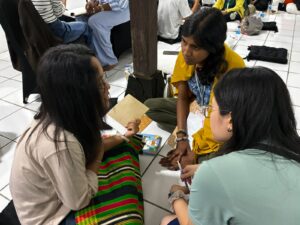
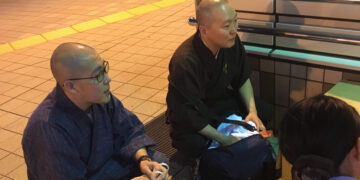
Revs. Takemoto and Fujii—affectionally called by their nicknames Take-chan and Nyanpa—then summarized this basic counseling session while introducing the group to the specific style of Sotto counseling. They emphasized that by resonating through the heart, the feeling of loneliness can ease. As opposed to most contemporary counseling and chaplaincy practices, they advised to not rely on so-called “listening skills”, which can sometimes make the client feel disengaged from a counselor who seems rather stoically unsympathetic. They encouraged participants to “simply feel the presence of the person before you and sway together, and to express what you feel in that moment through words and actions.” To illustrate these points, Take-chan and Nyanpa engaged in a typical pair counseling role-play that Sotto uses to train their counselors. They acted out two scenarios that reflect actual situations they have encountered in Japan:
- “I have had a disability since birth and live in a wheelchair. Yet my parents insist, ‘Be grateful for being born into this world.’ But I don’t want to be forced to feel gratitude. My mind is always filled with suicidal thoughts.”
- “I lost my young child in the great tsunami of 2011. Though we were holding hands, my strength gave out and I let go. It is my fault my child died. I wish I could die to apologize.”
What then took place between Revs. Takemoto and Fujii was powerful and for some quite alarming. They took about 5 minutes in silence to enter a space of deep emotional reflection: Rev. Fujii taking on the role of the client in a place of intense dysregulation and sorrow, while Rev. Takemoto taking on “the attitude you want to cherish”. In both role plays, the counselor “swayed” deeply with the client making sure to make a heart connection. As Rev. Takemoto noted, in a case where one has not made the connection, not become sotto, nor provided warmth, the words, “I know how you feel” or “You must be lonely,” will not resonate and may create further distance or even resentment from the client. However, with such connection, a sense of warmth and relief (hotto) will occur while easing the feeling of loneliness.
Participants were then given a chance to try the method themselves using four different suicidal role play scenarios: 1) deep remorse for harming a family member, 2) isolation from the loss of a partner, 3) business failure, and 4) continual abuse from a partner. At the end of the afternoon, the entire group including the other workshop leaders engaged in a lively discussion of Sotto’s methods, which highlighted the difference between working with someone in a short-term critical, suicidal situation and with someone in a long-term, problem-solving situation. Finally, as with the previous day, participants were called back in the evening to engage in a ritual practice for remembering those dear to them who have passed already. This was a recreation of the actual tsuito-hoyo memorial service for loved ones who have passed from self-death/suicide pioneered by suicide prevention priests in Japan over the last twenty years. Participants were first asked during dinner break to write a letter to a departed loved one. Returning to the meeting hall after dinner, the letters were collected on an altar, and Revs. Takemoto, Fujii, and Nemoto performed a memorial service with chanting. Then the letters were gathered and the priests led a procession out into the night to a nearby garden where the letters were burned in a large urn, transmitting their messages into the ether.
Highlights of the Nida Shaikh Workshop
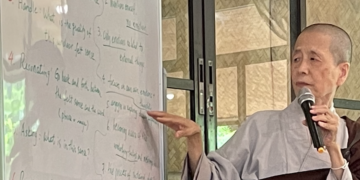
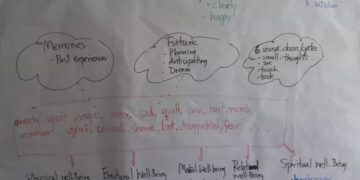
After the very physical and visceral experiences of the first two days, the third day under Nida Shaikh brought everything together by adding cognitive teachings to inner and relational work. Nida began the day with a definite Buddhist foundation in “challenging and dissolving the concept of self”. This was done through an exercise she called “Spotlight Adjective” to highlight the ever-changing nature of self. Participants were asked to describe themselves using 6 adjectives with the subsequent questions of: Were these adjectives applicable to you 5 years ago? How do you know “you” are these things you have chosen? She then had everyone develop 6 adjectives to describe an ideal self or what we aspire to be, with the subsequent question of: Have you ever been these adjectives even for a short time? A discussion then ensued of how we all are trapped in our need to have a permanent definition of self, which makes us attached to our preferred labels and adjectives, such as, “I am a very kind person.” This view makes us sensitive to others judgments and views of us. We categorize these labels into “good and “bad”, and suffering and despair then arise due to the gap between the current self and ideal self.
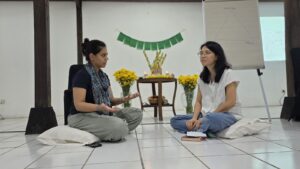
Nida then led the group through an activity called the Spotlight method that she developed herself, where one can allow oneself to have a changing definition and description of self. Role plays with 6 individuals were conducted in which each person acted out different adjectives in multiple scenarios of improvisational play, such as how one responds when driving and someone buts in front of one’s vehicle. Different social contexts and situations will bring out into the spotlight different aspects of ourselves. In the end, the “I” is a collection of spotlight adjectives, stage adjectives, and non-stage adjectives. As a counselor, Nida explained that we may facilitate a client to help them remember the ever-changing cast of selves in the spotlight and on stage in a way that they do not need to get attached to any ne. This activity helps to align with the Buddhist teaching that the self is malleable and impermanent. However, too often we see the absence of desired selves as permanent and so we panic and fall into despair, or what Nida termed as the anyone Self-Death Triangle.
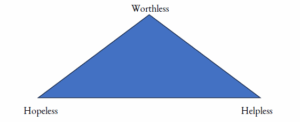
She explained that the person who experiences all three simultaneously for two weeks or more is highly prone to the ending the self, that is, self-death/suicide. In this way, Nida instructed as to how to identify which adjective the client is clinging to and to use their past and present to demonstrate the impermanced of that adjective by shifting the spotlight and re-shuffling the stage actors. If we can help the client feel any of the emotions of “worthy”, “helped”, or “hopeful”, she explained, then they can break the triangle.
In the afternoon, Nida facilitated an extended session on Inner Child Theory, which she has tweaked and developed her own version over years of practice. She has found this method works with any group with any mental and/or emotional struggle by providing steps to systematically learn how to be kind and compassionate to one’s own inner child. Nida primed the group in a surprising way by gathering everyone outside on an open green and having them re-enter childhood with a game of tag called Confusion. At the end, she asked everyone, “Which of your hidden parts came out during the game?” In Inner Child Theory there are many complicated aspects to our subconscious and conscious mind, so Nida talked about the three she emphasizes: the Inner Child, the Parent, and the Adult
- The Adult is the part of us that focuses on day-to-day activities and relies on the partnership of the Parent and the Child to get things done.
- The Parent is responsible for taking care of the Child and maintaining relationships with other people in our lives.
- The Child is the hub of all our emotions, desires, needs etc. and completely relies on the Parent but also watches the Parent very keenly.
Nida explained that we inherit various ideas from our biological parents and may choose to shed them as we get older and witness the world. However, usually, we tend to get embedded in what our parents transmitted to us as our identity adjectives. The question of analysis then becomes, “How does that Inner Parent voice continue to talk to the Inner Child and what is the reaction?” If the Child withdraws and becomes lonely, the overall self becomes broken. In the end, we need to learn how to talk to ourselves like we are a completely innocent person. Because we exist relatively, being witnessed is very important both by ourselves and by others. Being seen, heard, and understood by our Inner Parent is very important. However, to make our beliefs feel true, it is also important to be seen, heard, and understood by other people. After explaining these ideas, Nida led the group through a guided visualization that was done while lying down in a fetal position.
Imagine you are walking through your childhood school. It’s absolutely empty, but you know you have to look for someone that you love. You do not know who you’re looking for, but you know when you find them, you will know. So you search the halls, and you walk through the corridors looking into each class. You go from one class to another, and now you start to panic a bit because you cannot find this person. Finally, in the last classroom that you enter, you see a small child sitting in the corner facing away from you. The child looks familiar, but you are not so sure. You approach this child, and you see that they are hiding their face and crying. They tell you they have been scared and lonely. You hold the child, and they turn towards you and you finally see that this child is you. You have met your younger version. The child tells you they have been waiting for you for a very long time. They tell you they are upset with you for always putting them last, for pleasing others at the cost of the child, and always being so strict and mean to them. They tell you they are hurt, scared, and lonely.
You hold the child and you apologize. You don’t make excuses. You just apologize. The child breaks down crying in your arms in your lap and you keep comforting this child. You make a promise to be better. You make a promise to put the child first always. You promise to be kind to the child just as you are to other people you love. You tell the child that it will always come first for you, and you will always do everything to keep it safe, healthy, and happy. The child starts calming down, and you both just keep swaying together while you hug and hold the child. Slowly this child falls asleep, and as they sleep they merge into your body in the form of an energy that settles. You stay with the merger for some time, and you start to feel the reconnection again.
To end this activity, Nida had the participants write an apology and promise letter to their inner child. Finally, she offered some tips to help client on Inner Child Theory:
- Our presence is more important that the tools we use.
- When we start reflecting on the impermanence, interdependence, and parts of the client’s suffering, we need to develop an acceptance of their suffering and not obsess about getting rid of it.
- We can be present and hold the space of discomfort through curious questioning, which reflects interest and, therefore, importance. Advice reflects the need to change, which means the current situation is not allowed and entails a rejection of what is. The person actually knows their life better than you do.
- We use the tools to be curious, not to remove the client’s suffering. Especially for suicide prevention, these tools are: open ended questions; non-verbal cues like physical posture and voice tone; silence; compassionately pointing out contradictions in their descriptions of self and experience of life; paying attention to the labels they use for self and others; identifying specific needs and brainstorming on ways to create opportunities to fulfill them.
By the end, a large group discussion emerged on the whole day’s process, specifically, about how on a daily basis we carry our stage adjectives with us and, out of habit, we keep using only our spotlight adjective until the circumstances in the environment force us to use another.
Closing Reflections and Morning at Borobudur
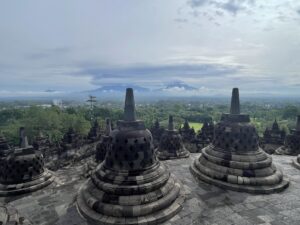
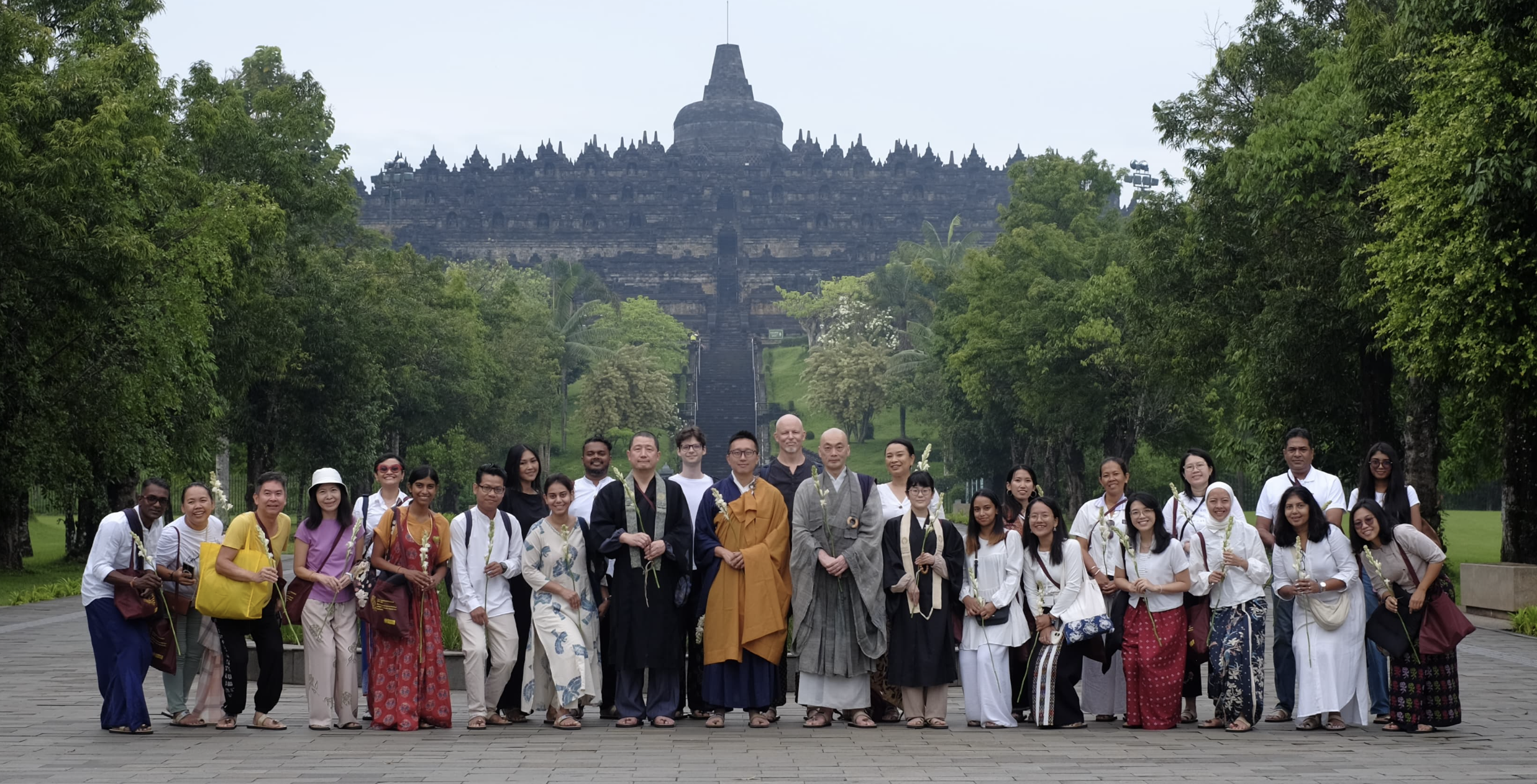
The workshop and week’s worth of activities came to a fitting conclusion with a morning pilgrimage to the great 9th century Mahayana/Vajrayana ruin of Borobudur, the largest Buddhist temple in the world and, along with Bagan and Angkor Wat, one of the great archeological sites of Southeast Asia. Hendrick Tanuwidjaja, author of the Indonesian language Soul of Borobudur: The Philosophy of Cakravartin’s Mandala, was the perfect person to lead the group through the vast grounds, all the way through the fantastic stone reliefs of the lower levels of the monument, and finally to the “purified” top level of stupas and Buddha images, signifying the formless realms of enlightened mind. From this level, participants got panoramic views of the multiple volcanos in the environs, which buried the monument for centuries under the ash of their explosions. Everyone felt the deep mystery of this sacred environment, which is known as the Kedu Plain, a sacred place for Javanese due to its agricultural fertility. As part of the closing ceremony that was held here, a group of participants took formal refuge in the Three Jewels of Buddha, Dharma, and Sangha and also received dharma names created by Rev. Nemoto.
While this workshop was specifically designed for lay persons, the injection of various rituals led by the Japanese priests created important psychological and emotional impacts that complemented the specific counseling and therapy tools being learned. Perhaps the Japanese priests with their strong lay orientations have a special flair for adapting ritual for lay persons. At this workshop, we were especially blessed to have such skillful ordained persons. This organizer is especially grateful to bring these practices and the wisdom of the Japanese suicide prevention priests to international audiences (for more on their work see Engaged Buddhism in Japan Vol. II). We hope this is just the beginning of further collaborative activities, and the fulfilling of the mandate of IBCC to cultivate high-quality Buddhist based counseling and chaplaincy skills in southern Asia. For more insights, see the testimonials and reflections of participants here.