



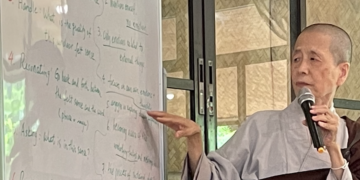
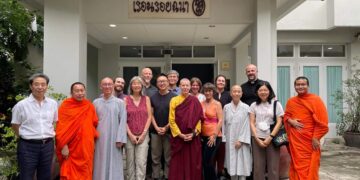

Ven. Youmin was ordained in 2007 and completed his PhD in Buddhist Studies at Kyoto University in 2026. He serves as the abbot and lecturer at Xian Ju Monastery in Malaysia, leading ceremonies, teaching, and mentoring practitioners. His training in meditation includes both Chinese Chan and Theravada traditions, emphasizing the Four Foundations of Mindfulness. He has also received training in Western counseling methods, incorporating practices such as deep listening and group facilitation. His approach combines traditional Buddhist practices with elements of modern psychology.
The three workshops in Japan gave me a lot to think about. I feel that the more important learning was about relationship. How do we stay with another person when there is suffering? How can a Buddhist temple become a place where people feel safe to bring their pain? And what is the role of a Buddhist monk when we meet suffering that cannot easily be solved?
Rev. Soin Fujio (Rinzai Zen) in Yokosuka & Kamakura
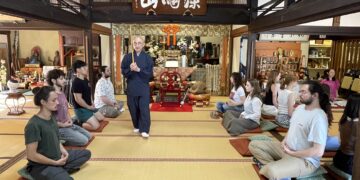
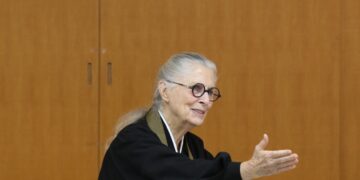
The workshop with Rev. Fujio gave me a different understanding of Zen practice and attunement. We practiced different forms of Zen meditation. One point that interested me was that people who are suffering themselves may sometimes respond better to moving meditation (動禅 do-zen), while caregivers may benefit more from sitting meditation (坐禅 za-zen). Sometimes in Buddhist teaching, we have a method and expect the person to fit into the method. Perhaps it should be the other way around. We need to see the condition of the person first, and then find a practice that can meet them where they are. This is also how I understand attunement. If somebody is very disturbed inside, asking the person to sit still for thirty minutes may not be helpful. Walking together or doing something together may be better. Sometimes the body can find stability before the mind does.
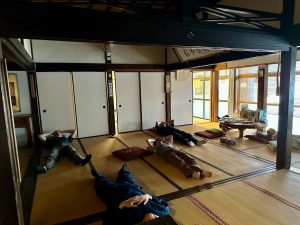
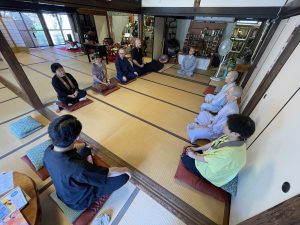
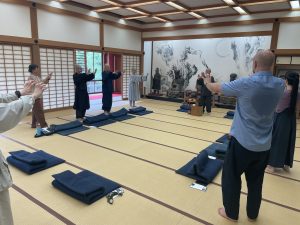
Rev. Fujio’s work supporting people who have lost family members through suicide made a strong impression on me. One small detail stayed in my mind: the movement from email to handwritten letters, which he does with the Association of Buddhist Priests Confronting Self-death and Suicide. Today everything is fast, but a handwritten letter has another quality. Someone needs to sit down, write slowly, and choose the words. The receiver can hold it and read it again. Perhaps this slowness itself is part of healing. I was also moved by the practice of hand carving a Jizo Bodhisattva image by oneself. The important thing is not whether the object is beautiful. The spirit is to create relationship. Grief can make people feel that their relationship with the deceased has suddenly been cut off. A handmade Jizo may become a way of remembering and continuing that relationship in another form.
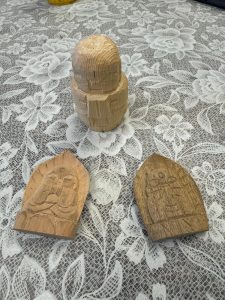 This also made me think about what temples can do. Sometimes we think we need a very professional program before we can help people. But one message I received was much simpler: just go back to your temple and reconnect. A temple already has many resources. There are monastics, rituals, and community. Maybe the first question is not, “What new program can we create?” but “How can we use what is already here to create relationship?” At the same time, good intention is not enough. I was impressed that monks involved in correspondence work received one to three months of training. They read old letters and studied how others responded. Compassion also needs training. A wrong word, even spoken with good intention, can hurt a person who is already vulnerable.
Rev. Ittetsu Nemoto (Rinzai Zen) in Gifu
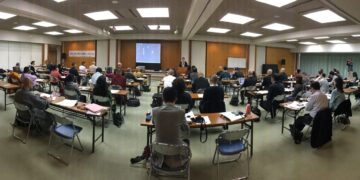
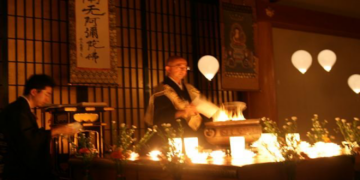
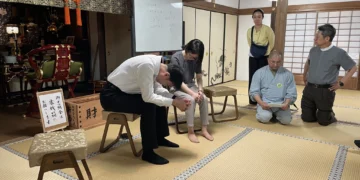
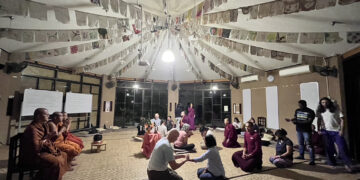
The death workshop called The Departure (旅だち tabidachi) was the most experiential of the three workshops we did. It included guided Zen meditation, vision boards, a death scenario using post-it notes, a mock funeral, a sunset walk, and reflection and sharing. What I appreciated was that death was not approached only intellectually. We did not simply discuss Buddhist teachings about impermanence. We were invited to feel what death means to us. The vision board was especially interesting because we used photographs and magazine clippings instead of words. Later, when we looked at where the images were placed, meaning sometimes appeared in places we did not consciously plan. What was in the center? What was pushed to the edge? Sometimes a person reveals something before they themselves fully understand what they are revealing.
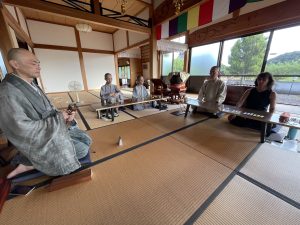
The death scenario with post-it notes was also powerful. When we imagine that life is becoming shorter and we have to gradually give up things that are important to us, death becomes less abstract. We begin to see our attachment. Some things that seem important in ordinary life suddenly become less important, while other things become more precious. For me, the value of this exercise is not to make people afraid of death. It is actually to bring us back to life. If something really matters to me at the end of life, why do I neglect it now? The mock funeral and sunset walk made death even closer. This gave me an important learning about teaching. We do not always have to explain the Dharma. Sometimes we can create conditions where a person experiences something, and then allow the Dharma to arise from the experience.
Sotto, the Kyoto Self-Death & Suicide Counseling Center
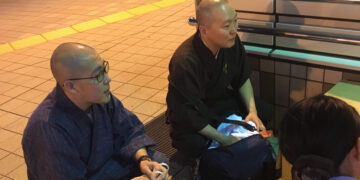
The third workshop challenged me the most. One finding that surprised me was that Buddhist monks can sometimes create harm instead of helping families grieving a suicide. Accordingly, only around 15 percent of monks in a study by the Jodo Shin Hongan-ji denomination (whose priests founded Sotto) had experience consulting people with suicidal thoughts. Many wanted to help, but some Buddhist teachings and traditional attitudes made it difficult for them to know how. This raised an uncomfortable question for me: can Buddhism’s way of talking about suffering sometimes unintentionally support suicidal thinking? Buddhism speaks about suffering, impermanence, samsara, and renunciation. With proper understanding, these teachings lead toward liberation. But for someone who is severely depressed or suicidal, the same words may be heard very differently.
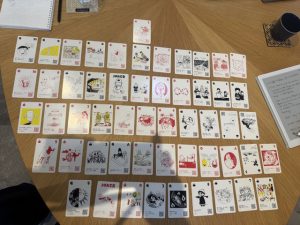
I was also interested in the Japanese change in language from 自殺 (ji-satsu, “self-killing”) to 自死 (ji-shi, “self-death”). Changing one Chinese character does not solve the suffering, but language affects how we see a person. When suicide is treated simply as something morally wrong, the family may carry shame in addition to grief. Sometimes changing language is the beginning of changing relationship. The Death Café organized through Wakazo gave me another model. I liked its basic value: death does not need to be either denied or affirmed. We can simply create a space to talk about it. The death playing cards had a similar spirit. Participants choose cards they like or feel uncomfortable with and talk about why. The purpose is not counseling and not to over-analyze the person. It is simply to bring death back into daily life. Not everything needs to become therapy. Sometimes a conversation is enough.
Rev. Takemoto’s presentation gave me another important lesson. Although Sotto is run by religious people, it does not have a religious goal. When a person says, “I want to die,” this is not the moment for us to prove Buddhism is correct or to convert someone. The first responsibility is to encounter the human being. The Buddhist idea of dependent arising can help us understand that the wish to die does not arise from one single cause. It arises from many conditions. We often emphasize self-practice in Buddhism, but sometimes another human being is the practice we need.
The discussion on loneliness and isolation was, therefore, one of the strongest parts of the week for me. One expression used in the workshop was like dancing with the person, vibrating at the same frequency, until gradually they become more stable. This is not controlling them or pulling them toward where we think they should go. It takes time. This is very close to my understanding of attunement. Sometimes just having one person beside us, who stands with us as an ally, can become a pillar for continuing to live.
Conclusion
After these three workshops, I do not think my first task is to create a suicide prevention program back home. I would like to explore how Buddhist temples in the communities where I serve can become safer places for people to talk about grief, loneliness, death, and emotional suffering. This may begin with Death Café style conversations, workshops about life and death, vision boards, meditation, or simply opportunities for people to sit and talk with a trained listener. I am also interested in developing training for monastics and Buddhist volunteers.
I also want to explore more experiential workshops. The Tabidachi workshop showed me that people can understand impermanence not only by hearing a Dharma talk, but through roleplay and ritual. Most importantly, these three workshops made me reconsider the role of a Buddhist helper. Maybe our role is not always to give answers. Maybe it is not even to remove suffering. Sometimes our role is to stay. To write a letter. To walk together. To sit together. To listen without being frightened by what the person says. To allow a person to speak about death without immediately correcting them.
I went to these workshops hoping to learn how Buddhism can help people who suffer. I came back with another question: how can Buddhism learn to stay closer to people when they suffer? For me, this may be the most important finding from the three workshops.